Sunday, September 25, 2016

Looking forward...


Zero To Three has always been an organization that is most appealing to me. Something that has drawn me to the group, is that all of their information is extremely user friendly. On countless occasions, I have recommended visiting the website to parents with infants or toddlers in order to gain some new perspectives or supports related to their specific situations, and the families had come back to me telling me how great the videos are, or how useful a particular article was. Regardless of SES or educational background, parents/caregivers with access to internet can locate and utilize their many resources. 

The International Play Association is one that has always served as an inspiration to me. Although the organization is international, theirs is a national chapter here in the U.S. The chapter was started in 1961, and is founded off of the United Nations' Declaration of the Rights of the Child (1959) Article 7, paragraph 3: "The child shall have full opportunity for play and recreation which should be directed to the same purposes as education; society and the public authorities shall endeavor to promote the enjoyment of this right," (1959). Not only does this organization spread the word of this law, it works to maintain and create legislature protecting play in the lives of children across our country. 

The Council for Professional Recognition is a U.S. organization that works to support professionals in the field of early care and education by keeping current on the latest findings and trends in the field. Just as it is important to support children and their families, we must also make sure that a great deal is being done to support all future educators, regardless of the length of their education. This particular organization works strongly to support CDA candidates through their development and regulation of credentials and assessments. 

One particular job that I have been interested in for a few years is that of a Lead Teacher at the University of Vermont's Campus Children's Center. As a teacher in this program, I would not only be responsible as a member of a Reggio Emilia teaching program for 2-5 year olds, but also for overseeing the work of practicum students from the university's education program. Having interviewed for this position a few years back, I was fortunate enough to see how involved the school community was. During the hiring process, I was interviewed by a panel of school administrators, university administrators, classroom teachers, and a panel of school families. Upon the conclusion of my final interview, I was required to participate on an open-forum panel led by families in the school community. It was a major fuel towards my passions behind support families in the school environment; I had seen a school community function so beautifully by collaborating greatly with families. 

Saturday, September 10, 2016

Some Favorites in the ECE Community

As I think of specific early childhood care and education advocacy groups that are highly appealing to me, the following three come to mind:
    • Campaign for a Commercial Free Childhood.
This organization is working within the early childhood community to address the growing issues of technology in our youngest children’s lives. I have seen the negative effects of over-commercialization in childhood, as well as the lack of technological literacy experienced by parents and caregivers. As the world is rapidly changing, this organization is working to support adults in appropriately exposing children to technology, as well as addressing the highly negative impact the commercial world has on children.
    • NAEYC
As an active member of NAEYC for the past several years, I have been fortunate enough to feel the power of it’s community. This specific organization houses several communities of practice, be in professionals dedicated to preserving play in early childhood classrooms, professionals dedicated to supporting health and wellness in young children and their families, along with a multitude of other issues. NAEYC has inspired me time and time again to remain active in the field, as they are one of the leader producers of research in the field within the U.S.
    • The Child Advocate
When I had first come across this organization, I was amazed to see how many specific topics they work to address. Aside from the range of topics, I was (and still am) totally awestruck with the clear availability of various supporting professionals within each topic. For example, when looking through the information published by the Child Advocate’s website regarding drugs and medications, specific research articles are available alongside links to additional (outside resources).

Looking at specific jobs within the field that I would be interested in, these are a few that stick out to me.
    • Family Advocate with Youth Advocates Program, Inc.
This specific role would require me to utilize my background and training in child development, as well as policy systems. As a family advocate with this non-profit organization, I would be responsible for providing home-based supports to young families with young children, home-school connections through relationships fostered at the child’s school setting, as well as center-based support groups.
  • Program assistant for Campaign for a Commercial Free Childhood
In order to assure my qualifications for this position, I would need to emphasize my own technological literacy. Along with that, I would be required to share in my enthusiasm and understanding of the impact the commercial world has on children. The job would specifically require me to help design campaign outreach, and maintain a level of flexibility when support different components of the organization's office. This position is ideal to me, as it would allow for me to see the many layers of a complex organization.

Sunday, August 14, 2016

Profile of a Volunteer


My little sister, Kaitlyn, has followed in the footsteps of her older siblings (my brother and me) and has spent the majority of her youth and young adulthood considering the needs of others over her own. In her undergraduate years, she had attended college in Baltimore and quickly became involved in her community. Not only was she the president of her University's Habitat For Humanity student chapter, but she also began to work as a volunteer within different community outreach organizations working to connect community members with access to health-care. While working with these community health organizations, she helped to file new and existing client information, and in the process was able to learn about a whole community of peoples from their own perspectives. The impact of her volunteer work lent to a positive growth in the community, as she was able to institute more effective systems for practitioners to connect records and provide the community members with the most accurate services. Yet, although her major efforts directly affected her community, they made an incredible impact on her own life. Where she had never worked within a community such as the impoverished Baltimore community, she was able to understand the depths of the the social issues that plague their city and their lives. As she worked both in HFH and these community health organizations, she learned that the city's heartbeat existed in the lives of it's most needy, and the systems that need to be in place in order for improvements in their lives do not exist yet. Although any advocate that works on behalf of children and families understands that the world we hope to live in is not here yet, we can each do our part to build it. 

Sunday, August 7, 2016

Using Social Media to Get Connected

Social media presents itself as a double edged sword. Something I find important to note, is that although social media can serve as an incredible tool for connecting stakeholders with information on topics that connect with them, it can also become a source for misinformation and negativity. Entering the social media world, one must realize how truly connected they are, the impact their words can have, and how important it is to speak intentionally into the world wide web. Technology is a sensitive topic of study, as it is so rapidly evolving we must be cognisant of our efforts to understand and utilize it to it’s fullest, and most rich potential.
Useful Social Media Tools
  • Twitter: This format allows for stakeholders to access quick resources and updates from within the field. Organizations such as Zero To Three utilize platforms like twitter to increase involvement in advocacy efforts for major movements including the Rally For Babies.
  • Facebook: This format allows for direct connectivity for advocacy groups. Facebook groups can be made public or private, allowing for controlled contributions towards informing and organizing stakeholders. Facebook allows for easy personalization for groups to invite new members, and share resources throughout.
  • Change.org: This format allows for advocate to create and distribute mass access to petitions for change.
  • Blogging- This format is a strong resource for helping advocate voice their opinions, and receive real time responses. Advocates can utilize this platform to inform the public of issues, share personal connections, and direct links to resources. This entire process is time logged, so advocates and stakeholders are able to track the movement and progress of their work.

Something I am curious of, is what we as a field can do to not simply utilize social media to spread our word, but how can we teach others to utilize it in the most effective ways? As children and families are becoming increasingly more active within these areas of technology, what resources are available to community members that support them in learning the vast depth of the the technological world, their connectivity, and how they can begin/continue to utilize social media as a direct facet of change for themselves and their families?

E-Advocate. (2011). Social media advocacy: Five influential steps. Retrieved from http://eadvocate.wordpress.com/social-media-advocacy-six-influential-steps/

Sunday, July 31, 2016

Advocacy Messages

"Discovering Nature"

Families do not have to travel far to connect with their loved ones in nature. The benefits of being outdoors do not require major efforts and far distances. Families now have access to a search database that will provide them with information about the different types and locations of natural spaces in their very neighborhoods.

"When kids spend time outdoors, they get the chance to explore, use their imaginations, discover wildlife, and engage in unstructured and adventurous play. Additionally, studies show they have lower stress levels, become fitter and leaner, develop stronger immune systems and are more likely to become environmentally conscious in the future," (US Forest Service, 2016).

This message reiterates a lifestyle that generations before us were naturally privy to. With the changing economy, and growing communities, many parents and young people are often at a loss of their options for outdoor recreation. Through this PSA, families are able to see that there is a quick, easy, and free way to find new natural spaces to enjoy. The PSA also provides short, quick bursts of data supporting the value that natural exploration has on both children and entire family units. 


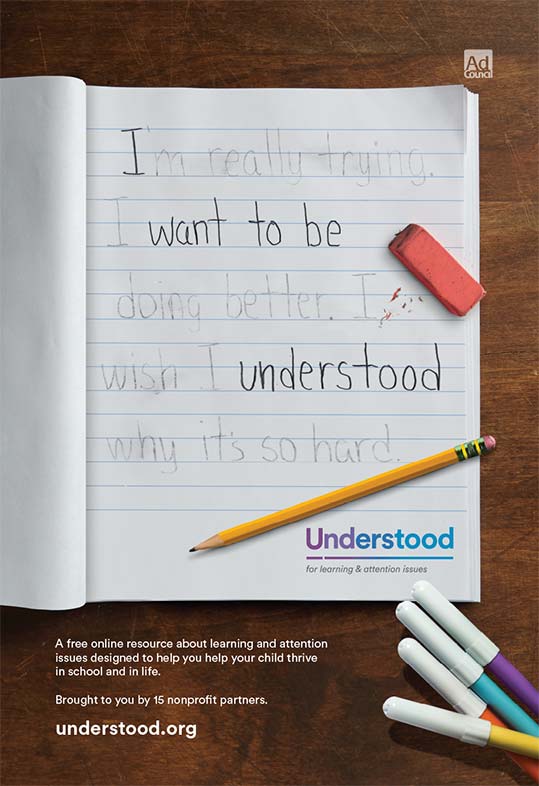
"Understanding is everything"
The simplicity of the visual depiction of this message is something that I found to be incredibly touching. The diagnosis of ADHD in young children is on the rise in the U.S. Approximately 6.4 million children ages 4-11 in the U.S. have been diagnosed with ADHD in 2011, and appears to be rising by 3% yearly (CDC, 2016). As many parents with children with ADHD may find that their patience runs thin, or that their child simply isn't trying, this message works to empower parents of children with attention challenges. It works to build an understanding that their child's struggles are not intentional, and that there are resources available for both parents and children. Rather than build frustrations, there are people and tools that will help to grow understandings of the causes of attention challenges, and solutions that can and will work. 


Center for Disease Control. (2016). Attention deficit hyperactive disorder (ADHD). Retrieved from http://www.cdc.gov/ncbddd/adhd/data.html#us

US Forest Service. (2016). Discovering nature. Retrieved from http://www.adcouncil.org/Our-Campaigns/Family-Community/Discovering-Nature#sthash.FThQ4iVx.dpuf

Sunday, July 24, 2016

My Own Capacity


One issue impacting young children and their families that fuels my passion for the field, is the issue of parents lacking support as their child's first teacher. I've come across family after family that is taken aback by my referring to them as the first teacher. So many parents take on the responsibility of parenthood, but are seldom given clear, useful help in regards to understand what that role really means. Rather than focusing on the things that parents can use to occupy or teach their child, we should be teaching them and pushing the understanding that their relationship is most important. 

I find that even though I find I constantly build new relationships across the field wth professionals and families alike, I am most grateful for my most reliable resource: my mother. My entire life, my mother had served as not only a mother to her children, but a caregiver to her older brother, and a shining example of advocacy in action. She always worked to inspire my siblings and me to find the joy in dedicating our time to helping other. Later in her life, my mom tackled the incredible feat of completing her Masters of Social Work, and later became a mobile response counselor for local children and families. As she, too, is fairly new to her field, she and I are always talking through possible solutions to our challenges, sharing our most thrilling discoveries, and seeking professional advice. It's been an inspiring experience to ease into the understanding of the social work field through someone I trust tremendously. I've been given many opportunities to understand the value of cross-profession collaboration in order to tackle the same goals. 

In order to be a more effective advocate, I would like to gain greater experience in identifying specific issues to tackle, rather than over-arching problems. I find that I struggle to set realistic goals because of this; I often struggle to hone in and focus on the small pieces as opposed to the complete product. 

Sunday, July 17, 2016

My Role as an Advocate

  • What motivated you to start advocating for very young children?
During my first year as an undergraduate practicum student in the ECE program at the University of Delaware, I became exposed to some of the most passionate educators and advocates I have since come in contact with. The teachers at the Lab School were (and still are) models of positive force in the field. I watched as these teachers shared their passion for the field in the early childhood classroom, in the undergraduate classroom, and out in their communities. They shared with me how meaningful their work was on a multitude of levels. From that semester on, I became a member of the Student Association for the Education of Young Children, working on my free time to head out into my community and support young children and their families. Through my earliest volunteer work, I found just how many levels of support go into successful ECE models, and how easy (as in natural to speak out on behalf of something that is so pure, full of life, and promising), fulfilling, and vast the work of an advocate is. 

  • Why is it essential to acknowledge and foster advocacy efforts at the micro as well as the macro level?
Every. Bit. Helps. No matter what population, what location, or what device an advocate uses in order to execute their efforts, their voice can make an impact at both micro and macro levels.

  • What does it take to be a community leader on early childhood issues?
A community leader on early education requires one to be willing to reach out to everyone. No effort is too small, and no community is not worth reaching. A community leader must be able to understand the development process of building policies, straight down to the beginning stages of compiling meaningful research. Community leaders must understand the immediate and future needs of their constituents, placing value on all issues, regardless of the personal connection he/she may have to it. 

  • What resources does it take to be a state leader on early childhood issues?
State leaders on early childhood issues must understand the vast needs and implications of child development. They must understand the vast sub-populations within their states, from incarcerated parents, to parents in high-powered, high-SES positions. State leaders must be able to link together all professionals that are involved in supporting children and families in ways that are meaningful to the common goals at hand. They must also be willing to collaborate across state lines in order to find the most effect tactics to combatting pressing issues.

  • What tactics or strategies do you use to mobilize others?
Shared information is one of the most effective strategies used to mobilize others. In order to effectively share information, though, one must be able to present it in a wide range of presentations. Different populations respond to different forms to campaigns, be it written, face-to-face, or visually represented through graphs, statistics, and general research. Linking individual stakeholders together by expressing to them their shared interests across issues and across communities must take place before action can occur. 

  • What advice would you give to someone who was interested in taking a leadership role in advocating for young children and their families?
Something I would implore a potential advocate for children and families to do is to get to know the population(s) who they are speaking on behalf of. It is one thing to read the research, but it is totally different to show your face. In the field of early care and education, we strongly believe in the power of relationship. The best way for change to occur, is to build a team to support the actions that must ensue. I would suggest taking time to build meaningful relationships not just with the families and children that would be affected by your proposed policies, but to also get to know all parties involved (i.e. professionals in the field that would be affected by policy, or could provide meanigful suggestions or feedback to join in your efforts).